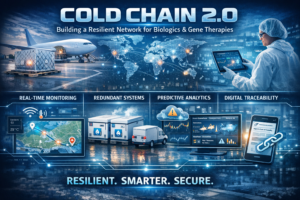
Cold Chain 2.0: Building a Resilient Temperature Controlled Network for Biologics and Gene Therapies
Cold chain failures don’t just cost money — they destroy product, delay treatment, and erode trust.
Biologics and cell/gene therapies demand a level of temperature control that legacy cold chain systems were never designed to handle. The next generation of cold chain — Cold Chain 2.0 — integrates real‑time monitoring, redundancy, predictive analytics, and digital traceability. It’s not about shipping colder. It’s about shipping smarter, with a network engineered for resilience.
Why Cold Chain 1.0 Is No Longer Enough
Traditional cold chain models were built for:
- Stable molecules
- Predictable shipping lanes
- Long shelf lives
- Limited global distribution
Today’s therapies break every one of those assumptions.
Biologics and CGTs introduce:
- Ultra‑narrow temperature windows (−20°C, −80°C, cryogenic)
- Patient‑specific batches with zero tolerance for loss
- Complex global handoffs across airports, depots, couriers, and clinical sites
- Regulatory scrutiny requiring end‑to‑end documentation
- Short stability profiles that magnify every delay
Cold Chain 1.0 was built for efficiency. Cold Chain 2.0 must be built for resilience.
The Four Pillars of Cold Chain 2.0
- Real‑Time Monitoring as the New Standard
Static data loggers tell you what went wrong after it’s too late. Cold Chain 2.0 uses:
- Live temperature and location telemetry
- Automated excursion alerts
- Cloud‑connected sensors
- Continuous lane performance scoring
This shifts the model from reactive investigation to proactive intervention.
- Redundancy Built Into Every Layer
Redundancy is not inefficiency — it’s insurance.
A resilient network includes:
- Backup packaging configurations
- Secondary couriers and lanes
- Redundant dry ice or LN2 replenishment points
- Contingency depots and cross‑docks
- Dual‑sourced critical components
If a single point of failure can break your chain, you don’t have a chain — you have a risk.
- Predictive Analytics to Anticipate Disruptions
Machine learning and lane‑level data now allow us to predict:
- Weather‑related delays
- Customs bottlenecks
- Airport congestion
- Carrier performance degradation
- Seasonal risk patterns
Cold Chain 2.0 doesn’t wait for an excursion. It prevents one.
- Digital Traceability Across the Entire Journey
Paper forms and siloed systems create blind spots.
Modern traceability requires:
- Unified digital chain‑of‑custody
- Serialized unit‑level tracking
- Integration with IRT/RTSM, WMS, and courier systems
- Immutable audit trails
- Real‑time site receipt confirmation
For CGTs, this extends to chain‑of‑identity — ensuring the right product reaches the right patient, every time.
What Resilience Looks Like in Practice
A Cold Chain 2.0 network is engineered to withstand:
- Flight cancellations
- Packaging delays
- Dry ice shortages
- Customs holds
- Temperature excursions
- Site storage failures
- Last‑mile variability
Resilience is not a feature — it’s an architecture.
The Shift From “Shipping” to “Orchestration”
Cold Chain 1.0 treated logistics as a linear process. Cold Chain 2.0 treats it as a real‑time orchestration layer that synchronizes:
- Manufacturing
- Packaging
- Couriers
- Depots
- Clinical sites
- Patients
- Data systems
The winners in the next decade will be the organizations that treat cold chain as a strategic capability, not a cost center.
Where Companies Struggle Most
Across biologics and CGT programs, the biggest gaps I see include:
- Overreliance on a single courier or lane
- Lack of real‑time visibility
- Inconsistent site readiness
- Poor integration between IRT, WMS, and courier systems
- No redundancy in packaging or replenishment
- Limited scenario planning
- Underdeveloped risk registers
These are solvable — but not with legacy thinking.
Cold Chain 2.0 Is Not Optional — It’s the New Baseline
As modalities become more fragile, personalized, and globally distributed, the cold chain becomes a clinical enabler, not an operational afterthought.
Organizations that modernize now will:
- Reduce excursions
- Accelerate timelines
- Strengthen regulatory compliance
- Improve patient outcomes
- Build trust with sites and partners
- Protect high‑value inventory
Those that don’t will feel the consequences in shortages, delays, and escalating costs.
Final Thought
Cold Chain 2.0 is not about moving boxes. It’s about protecting therapies that patients depend on — therapies that often have no backup batch.
A resilient cold chain is a resilient clinical program.