
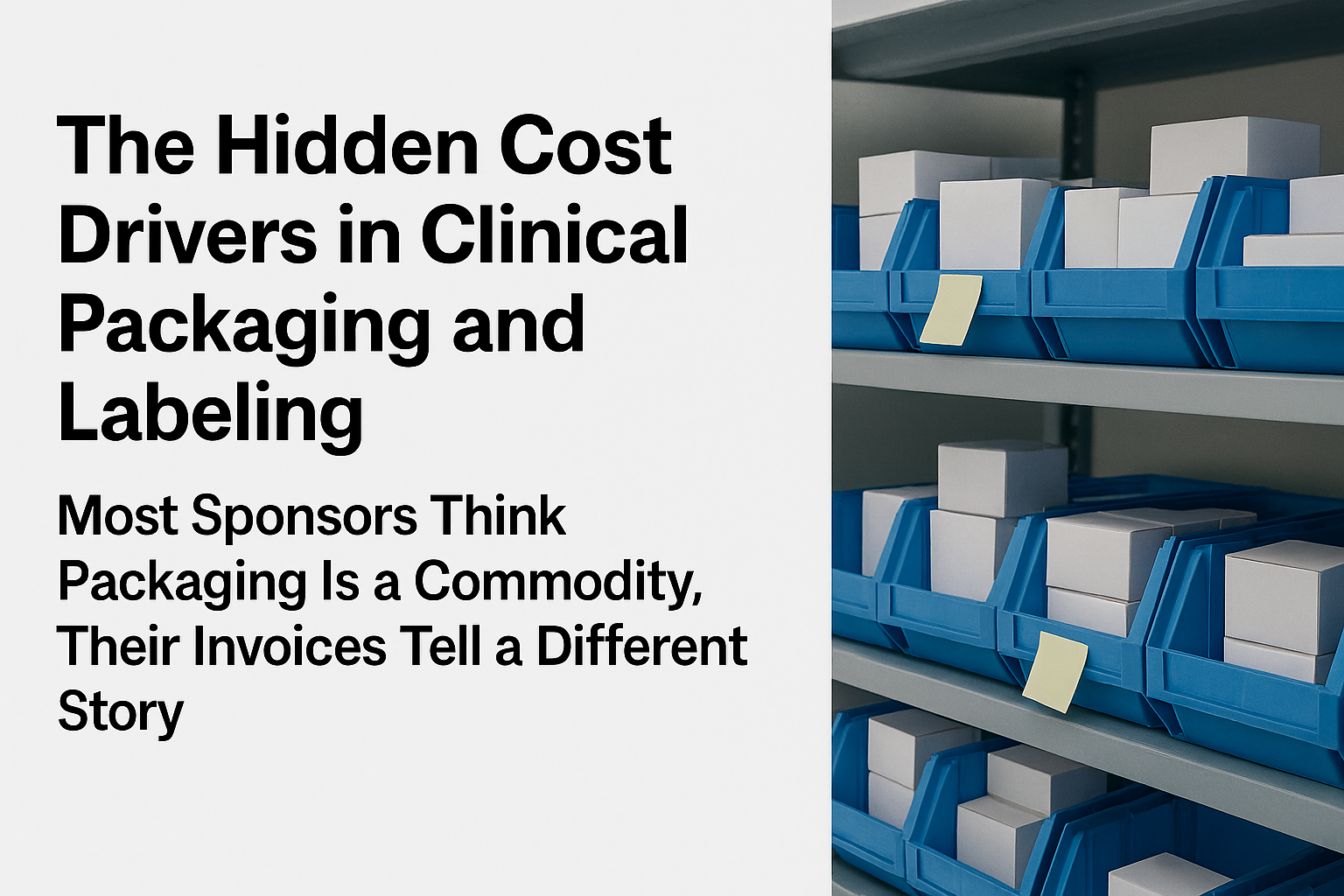
The Hidden Cost Drivers in Clinical Packaging and Labeling: Most Sponsors think packaging is a commodity; their invoices tell a different story
What if the biggest financial leak in your clinical trial isn’t your drug, your depot, or your comparator—but the packaging decisions your team made long before the first patient was enrolled?
Clinical packaging and labeling quietly consume more budget than most teams realize. The real cost drivers aren’t materials—they’re changeovers, artwork cycles, batch sizes, and the operational inefficiencies buried inside vendor workflows. When sponsors understand these drivers, they stop overspending and start designing packaging strategies that support speed, flexibility, and cost control.
Packaging Isn’t a Commodity—It’s an Operating Model
Most sponsors still treat packaging as a simple transactional step: “a box, a label, a kit.” But invoices tell a different story. The real spend comes from the operational friction behind the scenes—friction that compounds with every amendment, every country, every SKU, and every late decision.
Your packaging vendor isn’t just printing labels. They’re running a miniature manufacturing operation on your behalf. And like any operation, the cost is driven by time, complexity, and variability—not cardboard and glue.
The Four Cost Drivers That Quietly Inflate Your Budget
- Changeovers that multiply with every variant
Every new kit type, label version, or country-specific configuration triggers a full reset of the packaging line.
– Line clearance
– Equipment setup
– QA verification
– Documentation resets
These aren’t small tasks. They’re hours of labor and downtime. A single changeover can cost more than the materials for the entire batch it supports. When teams create unnecessary kit variants, they unknowingly create unnecessary cost.
- Artwork cycles that drag timelines and budgets
Artwork is where clinical speed often goes to die.
– Multiple stakeholders
– Translation cycles
– Regulatory nuance
– Version control
– Approval bottlenecks
Every iteration adds time. Every reprint adds cost. And every amendment—no matter how small—ripples through the artwork process like a shockwave.
- Batch sizes that create waste instead of efficiency
In commercial supply, large batches drive economies of scale. In clinical supply, they drive waste.
– Slow recruitment
– Country delays
– Expiring IP
– Protocol amendments
Right-sizing batches and using late-stage customization can cut waste dramatically. The smartest sponsors treat packaging as a dynamic process, not a one-time event.
- Vendor workflow inefficiencies you never see
Not all vendors are built for clinical agility. Many still rely on:
– Manual reconciliation
– Fragmented scheduling
– Long queue times
– Rigid QA cycles
These inefficiencies show up on your invoice as “rush fees,” “minimum charges,” or “unexpected delays.” But the root cause is operational—not material.
Why Sponsors Overspend Without Realizing It
Overspend happens because packaging is treated as a commodity instead of a strategic lever. When teams assume packaging is fixed and simple, they lose control of:
– Lead times
– Waste
– Amendment impact
– Vendor efficiency
– Total cost of ownership
The result is a study that costs more, moves slower, and absorbs more operational risk than necessary.
What High-Performing Sponsors Do Differently
The most effective clinical teams shift their mindset. They:
– Engage supply chain early in protocol design
– Minimize kit variants to reduce changeovers
– Streamline artwork cycles with early alignment
– Use late-stage customization to reduce waste
– Push vendors for transparency on workflow bottlenecks
– Build packaging strategies around **speed, flexibility, and cost control**
This isn’t about squeezing vendors—it’s about designing smarter operations.
The Bottom Line
Clinical packaging isn’t a box. It’s a system.
And when sponsors understand the system, they stop treating packaging as a commodity—and start using it as a competitive advantage.
#ClinicalSupplyChain, #ClinicalPackaging, #PharmaOperations, #StudyStartUp, #SupplyChainLeadership